

Data center cooling
Liquid cooling for high-density data centers
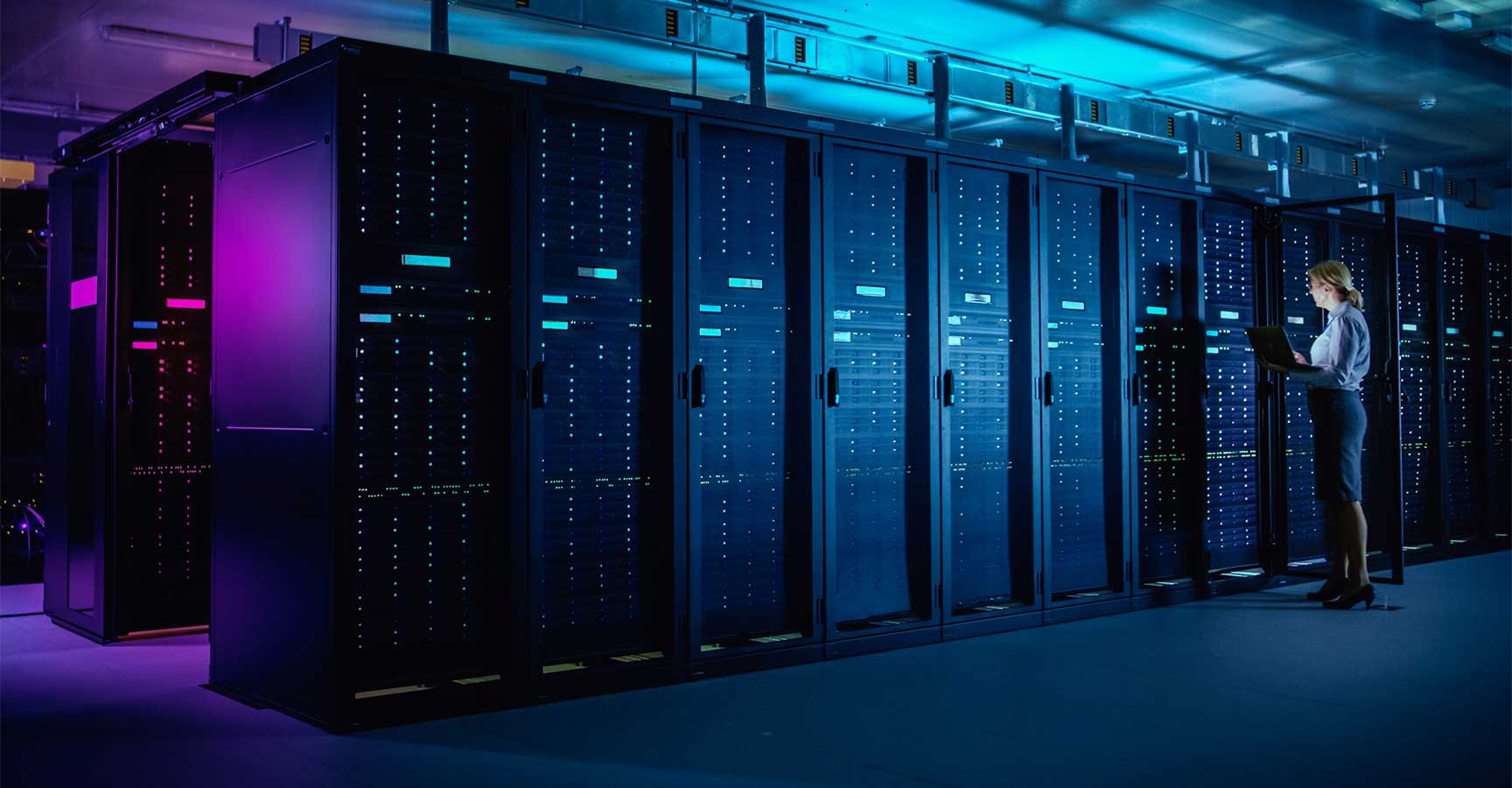
The demand for high-density data centers that can handle extreme processing loads is exploding. Modern computing workloads – especially AI – require far more power and cooling per server rack than traditional applications. SWEPs heat exchangers can help optimizing both OpEx and CapEx in a data center. Our compact, high-performance, BPHEs can be optimized for reliable operation across many different cooling applications including CDUs and GPUs, chillers, free cooling, economizers and heat reuse.
Built for density. Engineered for performance.
While traditional racks consume about 5-25 kW per rack, modern AI racks routinely consume 80-250 kW or more, – well beyond the capacity of air-cooling. And as compute density continues to rise, next-generation data center infrastructure is expected to support racks that consume 500 kW to 1MW each. With a complete range of compact BPHES, SWEP help optimize liquid cooling systems, supplying exceptional thermal and hydraulic performance that results in reliable operation in demanding environments.
The future of data center cooling
For many operators, energy efficiency is no longer the primary challenge. They demand systems that deliver accurate thermal performance, stable operation, and design flexibility. They also need to know that their cooling infrastructure can keep pace with rising rack densities and evolving workloads, including the accelerating demands related to AI development.
Where SWEP fits into liquid-cooling architectures
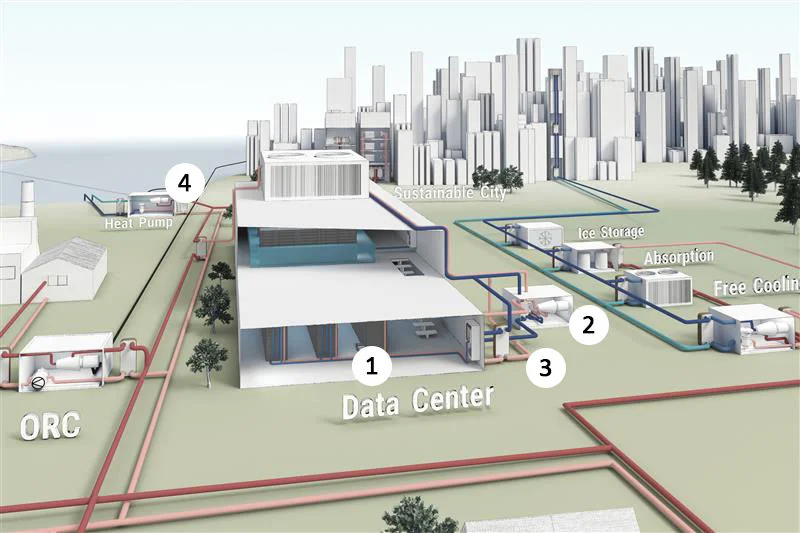
SWEP BPHEs are designed to support liquid-cooling systems in high-density data centers. They are vital to efficient heat transfer within coolant distribution units such as in-rack, in-row, and perimeter liquid cooling but also within free cooling systems, mechanical cooling systems, heat-recovery configurations, and other architectures. For data center designers and cooling-system partners, SWEP enables compact system layouts, strong thermal and hydraulic performance, and reliable integration in environments where space, temperature control, and deployment flexibility matter.
1. CDUs
SWEP BPHEs deliver accurate control and balanced pressure drop for in-row, in-rack, and perimeter liquid-cooling.
SWEP BPHEs with single- and dual circuits are adapted for natural refrigerants, delivering excellent reliability with a low charge.
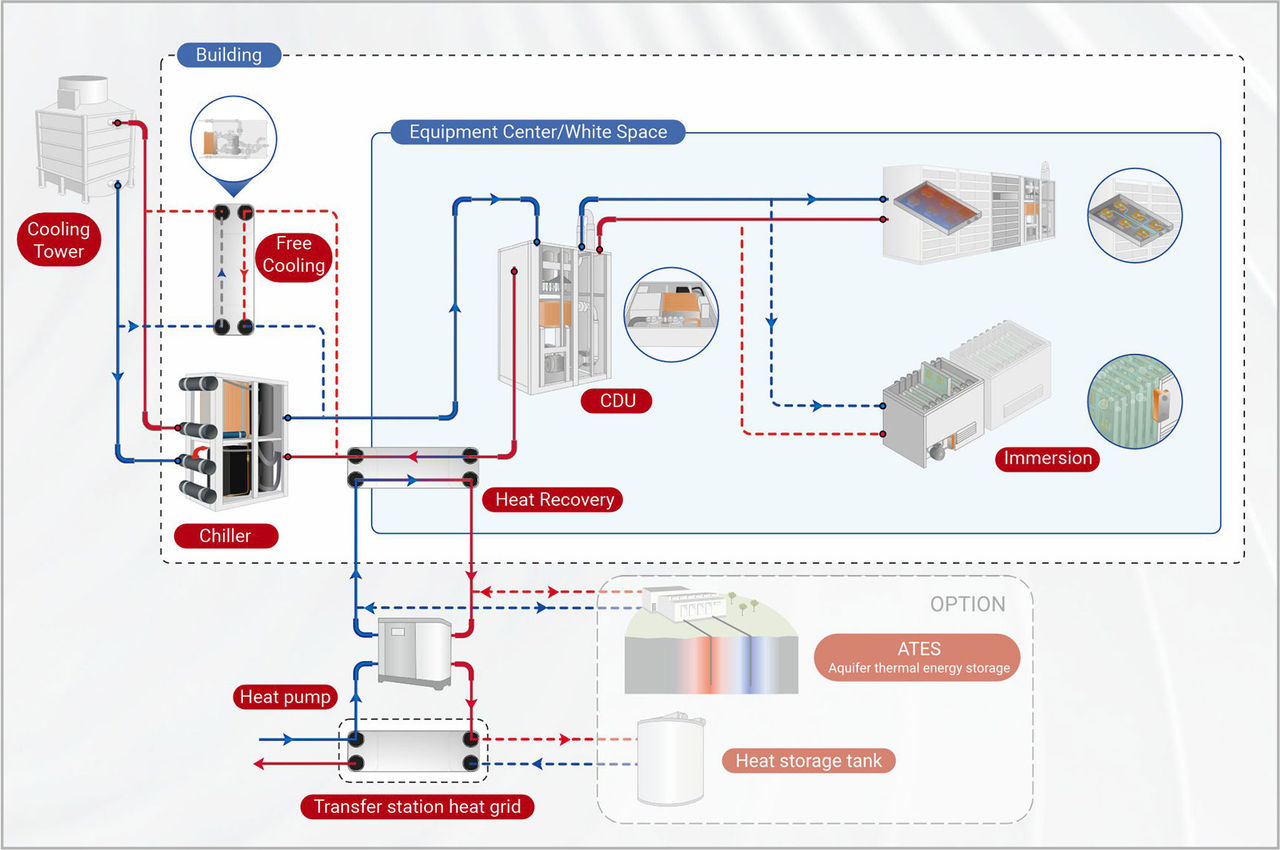
SWEP BPHEs have a tight temperature approach that enables free cooling even at small temperature differences.
Compact SWEP BPHEs make it easy to capture and reuse heat.
Why SWEP?
- Accurate thermal performance. Very small footprint
In CDU and other liquid-cooling applications where space and thermal demands must be carefully balanced, SWEP helps designers achieve strong heat-transfer performance without expanding the system’s footprint. Our market leading calculation and configuration software SWEP SSPTM is built upon real tests and give an accurate prediction of the cooling performance. As much as 95% of the material in our BPHEs is used for heat transfer creating more cooling per sqm. - Reliable support for mission-critical infrastructure
Cooling decisions are closely tied to uptime. SWEP heat exchangers are a robust component of data-center cooling solutions, maintaining stable operation in demanding environments throughout the entire lifetime of the system. Our leak-free and service free BPHE design is reducing the down time significantly, still able to provide long life-time, are built with high standards in materials and are all tested before being shipped out to customers. In addition we are AHRI certified. For safe and reliable performance. - Built for evolving cooling architectures
By supporting a range of applications – from CDUs to mechanical cooling, free cooling, and heat recovery – SWEP helps our data center customers build flexible, next-generation cooling systems. SWEP BPHE can easily be tailored upon customers application criterias thanks to modular and felxible production set-up. - Efficiency and heat recovery
As always, SWEP delivers unparalleled efficiency, lowers the cooling burden, and makes it possible for data center operators to recapture and reuse energy. With a liquid cooled system it is easier to capture waste heat, even at low temperatures.

Ready for High-Density AI
Supports 100–250+ kW racks for modern GPU clusters

Efficient Heat Removal
Liquid cooling removes high heat loads while reducing energy usage

Unlimited Scalability
Expand AI compute capacity without increasing data center footprint
Liquid cooling for high-density data centers
SWEP brazed plate heat exchangers (BPHE) are the core of liquid-cooling systems for today’s high-density data centers.
In single-phase direct-to-CPU or GPU cooling, a liquid coolant—typically water or a water-glycol mixture—circulates through cold plates mounted directly on high-power components such as CPUs and GPUs. The coolant absorbs heat and is then cooled through a heat exchanger within a coolant distribution unit (CDU) before recirculating.
Two-phase direct-to-chip cooling uses dielectric (non-conductive and non-flammable) liquid circulating through cold plates, instead of water, to cool the equipment. Absorbing heat from the components, the liquid boils and changes to vapor. The vapor is then condensed back into liquid through a heat exchanger and recirculated. Two-phase systems can remove very high heat loads while maintaining tight temperature control.
SWEP brazed plate heat exchangers help AI cooling systems operate at peak efficiency. We offer a complete range of brazed plate heat exchangers optimized for use in CDUs, mechanical cooling, and free cooling. They enable efficient heat transfer, higher cooling capacity, and lower energy consumption across the entire thermal management system.
AHRI CERTIFICATE
Propylene and ethylene glycol are now part of SWEP’s AHRI certification
To further enhance the efficiency and performance of our Liquid-to-Liquid Brazed Plate Heat Exchangers, SWEP has added propylene and ethylene glycol as valid fluids for a range of models designed for data center cooling, district heating, district cooling and other demanding HVAC applications. Air Conditioning, Heating, and Refrigeration Institute (AHRI) certification is a globally recognized program that ensures products perform according to manufacturers’ published claims.
Sustainability
Heat recovery
Sustainable data centers start with SWEP
Advanced liquid cooling systems featuring SWEP brazed plate heat exchanger technology are your key to sustainable data centers. SWEP BPHEs can help you increase efficiency, lower cooling costs, and reduce maintenance. And by making it possible for you to recover and reuse the energy in your system, they can help you transform from an energy user to an energy supplier.

“There must be a better way to make the things we want, a way that doesn’t spoil the sky, or the rain or the land.”
— Paul McCartney
Address
SWEP International AB
PO Box 105
261 44 Landskrona
Sweden
Follow Us

Copyright © 2026 SWEP International AB, a Dover company
Follow Us

Copyright © 2026 SWEP International AB,a Dover company