

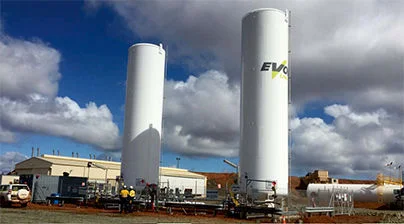
EVOL LNG uses SWEP brazed plate heat exchangers as LNG vaporizers
The customer: EVOL LNG, one of Australia’s leading suppliers of liquid natural gas (LNG) for transport, power generation, and industrial applications.
The challenge: Prevent icing and save space in LNG evaporators at an Australian gold mine.
The solution: Replace ambient-air cooled vaporizer units with brazed plate heat exchanger technology that uses a glycol loop.
The heat exchangers: SWEP B60 and B12 brazed plate heat exchangers.
The results: Prevented icing, eliminated need for a drainage system, assured continuous performance, improved mobility of the system.
Always striving to find more efficient solutions
EVOL LNG, a leading provider of LNG, built one of the world’s first power stations that employs brazed plate heat exchangers as LNG vaporizers. In a traditional LNG process, liquefied petroleum gas (LPG) is extracted from natural gas at an LPG extraction plant before being sent to an LNG plant. The natural gas is further treated to remove CO2 and moisture, before being cooled to cryogenic temperatures for liquefaction (approximately -145°C). Before being loaded for transport, the LNG is stored in an insulated sphere. At the site of the power station, the LNG is released into vaporizers, which use ambient air for the evaporation process.
The EVOL LNG power station was installed at a gold mine in Perth, Australia. Located 540 km from the nearest supply point, the mine has a processing capacity of 480 kilo-tons per annum and has 2 x 90 m³ LNG storage vessels. According to Mark Lindup, LNG Market and Project Development Manager for EVOL LNG at the time the facility was built, “You would normally use multiple ambient vaporizer units, as you need to factor in a thaw cycle so that any built-up ice can be shed. So, a typical 1-on/1-off cycle would switch every 4 – 8 hours, depending on ambient conditions. For an ~25 ton-per-day project, we would normally use 2 x 2 banks of vaporizers, with a footprint of roughly 2 m x 2 m x 6 m per vaporizer.”
The role of SWEP brazed plate heat exchangers
Traditional, air-cooled evaporators have several limitations. At 6 m tall, they consume significant space. Low ambient temperatures create a risk for freezing and ice in the evaporator, impacting performance. Traditional LNG vaporizers also require a drainage system. By using SWEP brazed plate heat exchangers, which use a glycol loop, instead of air, to cool the vaporizer, EVOL LNG has solved these issues. SWEP BPHEs prevent freezing and icing, eliminate the need for a drainage system, and ensure reliable, continuous performance. Because they are compact, SWEP BPHEs also make the system semi-mobile, and able to move from one site to another. This makes the system both cost-effective and environmentally-friendly.
Why choose SWEP?
Instead of a traditional solution that uses ambient-cooled vaporizers, EVOL LNG installed SWEP B60 and SWEP B12 brazed plate heat exchangers at the site. The B12 units utilize waste heat from the generator-set’s jacket water to warm a 65% glycol solution. The glycol is then circulated through the B60 units, where it is used to vaporize the LNG. The natural gas is then piped into the same generator-set, where it is burned in the dual-fuel engines. “For this project, I chose 2 x B60, rather than one larger unit, for the sake of redundancy,” says Lindup. “If one of the units fails, we can at least supply ~10 tons-per-day to the customer, while replacing the failed unit.” The installed generating capacity is 7 MWe and it has a dual, diesel and LNG, fuel supply.
More about EVOL LNG
EVOL LNG is one of Australia’s leading providers of LNG for transport, power generation and industrial applications, and has been in operation since 2001. EVOL LNG provides trucked natural gas to fuel off-grid power stations, delivering solutions with lower capital costs than natural gas pipelines and lower fuel costs than diesel. The company specializes in reliable, sustainable LNG solutions, and offers an extensive range of LNG sources and distribution capabilities. They are part of the OCTA group of companies, which also includes Clean Energy Fuels Australia (CEFA) and PWR Hybrid.
More related stories
Related case stories
Gas system
Milk production is one of the main economic activities in Brazil and the country is currently the sixth largest producer in the world. This sector is responsible for the production of up to 25 billion liters of milk a year and the product is a large part of the nutritional diet of most Brazilian families. When a more efficient cooling solution was needed during the milk production process, SWEP brazed plate heat exchangers helped make it happen.
Gas system
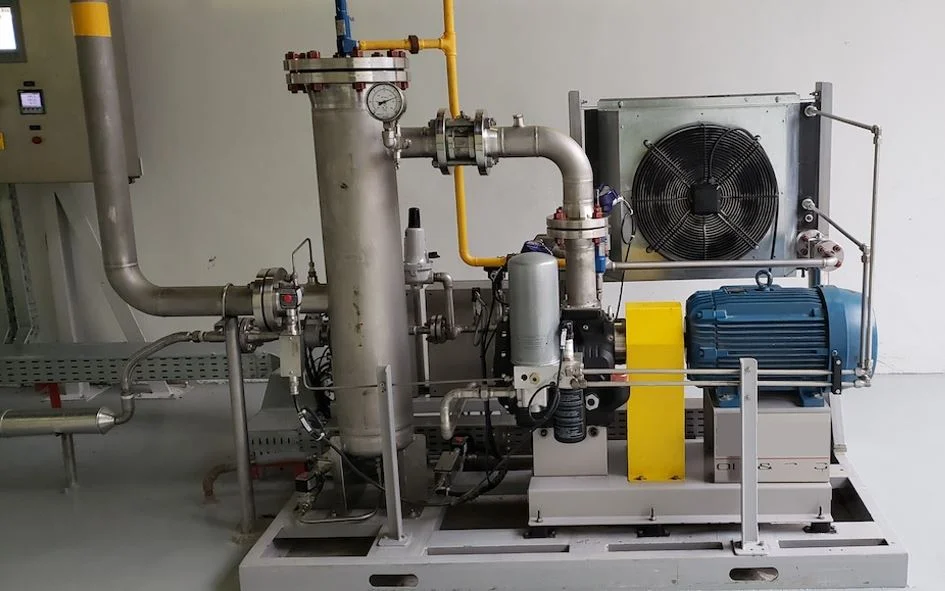
One of the world’s first power stations with brazed plate heat exchangers LNG vaporizers has been installed at a gold mine in Perth, Australia. The company behind the project, EVOL LNG, is a leading provider of LNG for transport, power generation and other industrial applications. It provides a trucked natural gas solution to fuel off-grid power stations and deliver a solution with less capital cost than natural gas pipelines and with lower fuel costs than diesel.
Address
SWEP International AB
PO Box 105
261 44 Landskrona
Sweden
Follow Us

Copyright © 2026 SWEP International AB, a Dover company
Follow Us

Copyright © 2026 SWEP International AB,a Dover company