

To reduce operating cost, FWN chooses reliable, high-quality SWEP units for Cool Steamdesalination technology
The customer: Fresh Water Nature (FWN), a clean-tech company that specializes in desalination with a low-impact, low-carbon technology called Cool Steam.
The challenge: Use renewable energy or recovered heat from other industrial processes to fuel the Cool Steam process.
The solution: SWEP brazed plate heat exchangers harvest and dissipate low-grade heat, driving evaporation and condensation in Cool Steam production.
The heat exchangers: At the start of the project, compact SWEP B3 and B25 BPHEs were used to perform phase change under vacuum conditions. As the project has developed, larger heat exchangers have been put in place.
The results: SWEP BPHEs play a key role in multiple Cool Steam processes, including desalination and electrolysis, as well as in Cool Steam applications in agriculture, food, cosmetics, and zero liquid discharge (ZLD). Their quality and reliability reduce operating costs in all of these processes.
Desalination projects widespread use
In recent decades, over-exploitation, pollution and climate change have led to severe water stress, globally. While desalination can help address this issue, large-scale desalination technologies are energy intensive. With the help of SWEP brazed plate heat exchangers, Spanish-based clean-tech company Fresh Water Nature (FWN) is working to change that. SWEP has been providing heat exchangers and technical support to FWN since 2015.
Based on once-through, multi-stage, low-temperature vacuum distillation, Cool Steam has several advantages over reverse osmosis (RO), which is currently the most common method of desalination. Per m3 of desalinated water, Cool Steam consumes approximately half the electrical energy of RO and significantly reduces CO2 emissions. It also produces substantially purer water than does RO, which can then be used – without additional processing – in a variety of demanding applications. Cool Steam technology also uses a cost-free dilution process to lower the concentration of salts and other substances in brine before it is discharged, mitigating its negative impact on marine ecosystems.
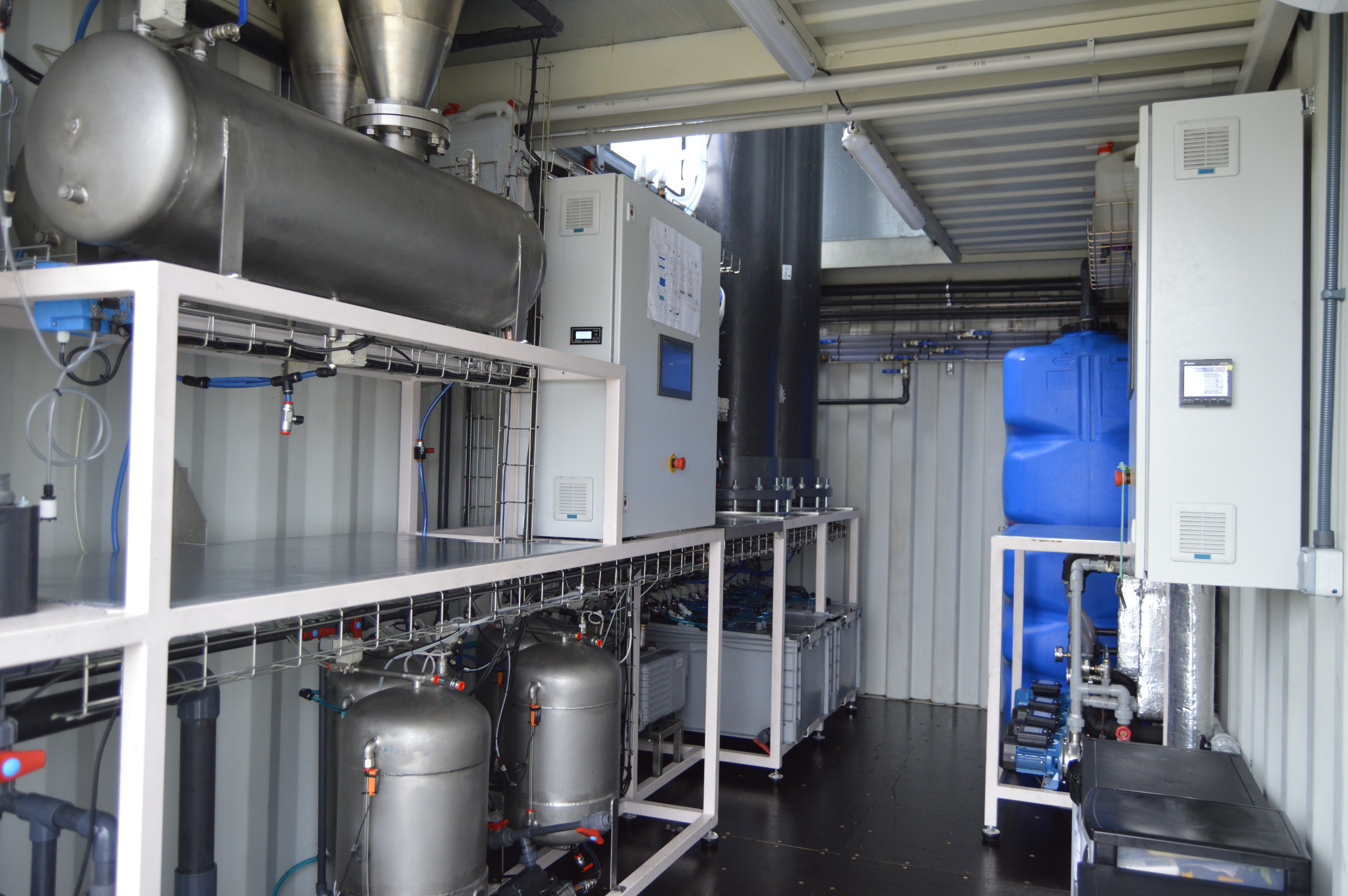
A look inside the operational demonstration plant in Barcelona.
From desalination to green hydrogen
Cool Steam desalination technology also supports cost-effective, emission-free production of green hydrogen through water electrolysis. Electrolysis consumes large quantities of water for cooling, however, and requires ultra-pure water as a raw material. Cool Steam can be used both to cool electrolyzers, reducing their operational cost, and also to supply ultra-pure water (following electro deionization), lowering the cost of raw materials.
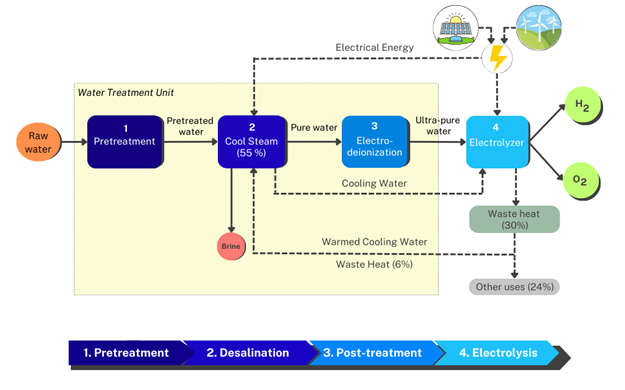
How Cool Steam desalination supports green hydrogen generation.
Electrolysis releases waste heat. With the help of a heat recovery system featuring SWEP BPHEs, this heat can be used as an input to the desalination process. Combining Cool Steam desalination with electrolysis enables surplus outputs to be transformed into useful inputs throughout the process, moving the entire solution toward circularity. This system has been successfully validated at a pilot scale in an LNG Regasification Plant. Electrolysis in the plant uses water from the Cool Steam process, while Cool Steam utilizes the waste heat released by the electrolysis.
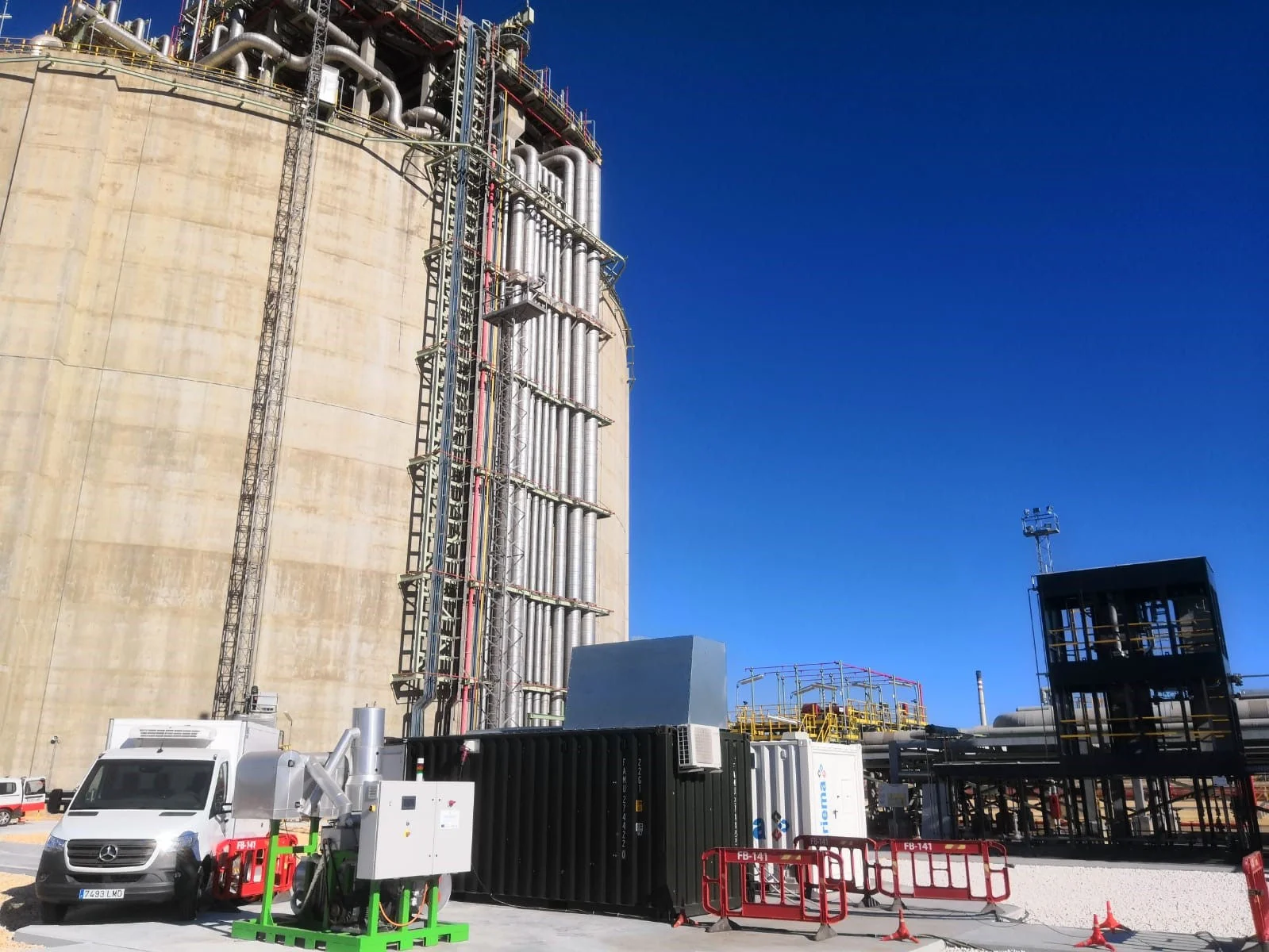
Cool Steam pilot testing for green hydrogen production by electrolysis.
An operational demonstration unit at the Barcelona Desalination Plant, can be transported by truck or ship to clients’ facilities for field pilot-testing. These fully-automated mobile plants can produce fresh water with a conductivity as low as 10µS/cm and 55% conversion rate. The minimum activation point for these devices is just 60 °C. Additional Cool Steam projects are planned for both Spain and India.
The role of SWEP brazed plate heat exchangers
Three heat exchangers were used in the electrolysis part of the process – for stack cooling, oxygen recovery, and hydrogen recovery. An additional three heat exchangers were used in the desalination process – for heating, cooling and cryogenic temperature cushioning. SWEP has also played a key role in additional Cool Steam applications in agriculture, food, cosmetics, and zero liquid discharge (ZLD) processes.
The thermal energy that Cool Steam requires can be generated from renewable sources or recovered other industrial processes. SWEP BPHEs can both harvest and dissipate thermal energy from low-grade heat sources to drive water evaporation and condensation in various stages of Cool Steam. At the start of the project, compact SWEP B3 and B25 BPHEs were used to perform phase change under vacuum conditions. In the ensuing decade, larger heat exchangers have been put in place.
Why choose SWEP?
FWN has chosen SWEP products for Cool Steam because of their quality and reliability, advantages that reduce operating costs. In addition to supplying heat exchangers, SWEP's Iberian staff supported with technical knowledge in innovative ways. As Engineer Naeria Navarro at FWN explains: “SWEP had an important role in this project as technological adviser. SWEP engineer Giancarlo Soler Zabala was helpfully involved with heat exchange system design and sizing, as well as the integration of all components within the overall system.”
More about Fresh Water Nature
The Fresh Water Nature (FWN) story begins with the International Center for Numerical Methods in Engineering (CIMNE). CIMNE is a research center that originated from a consortium involving the Government of Catalonia and BarcelonaTech (also known as the Technical University of Catalonia). More than a dozen companies have emerged from CIMNE as spin-offs and start-ups, working in areas as diverse as civil engineering, robotics, data analysis, meta-materials and inflatable structures. FWN was founded in 2013 to work on the final development phase and market transfer of desalination and water treatment technologies developed in CIMNE, bridging the gap between academic research and commercially viable applications.
More related stories
Related case stories

Industrial heating and cooling
SWEP’s robust All-Stainless brazed plate heat exchangers helped provide optimized cooling for sheet metal laser cutting equipment where deionized water is the main coolant. The copper-free chiller system was imperative to maintain the integrity of non-conductive coolants.

Industrial heating and cooling
Green Resource Engineering (GRE) wanted to create two new process cooling systems that can operate at higher temperatures and a smaller version that could also operate in reverse as a heat pump.
Address
SWEP International AB
PO Box 105
261 44 Landskrona
Sweden
Follow Us

Copyright © 2026 SWEP International AB, a Dover company
Follow Us

Copyright © 2026 SWEP International AB,a Dover company