

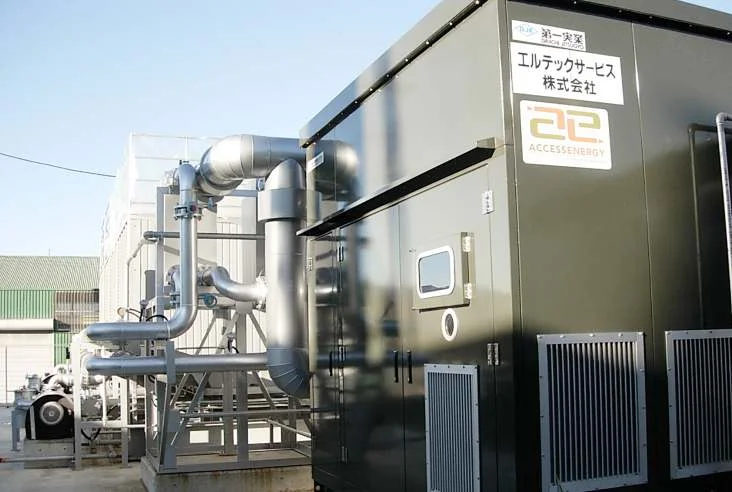
New ORC system for Ertec turns waste heat into clean power
The customer: Daiichi Jitsugyo, Ltd, a next-generation engineering firm, based in Japan.
The challenge: Install an ORC system in a new waste incineration plant owned by their customer, Ertec.
The solution: Collaborate with SWEP to build a 125 kWe-capacity ORC plant for Ertec.
The heat exchangers: The ORC system uses the B649, SWEP’s most powerful heat exchanger.
The results: Thanks to the new ORC system, Ertec is able to recover heat from the incinerator’s flue gas and convert it into electric power that can be used on-site or sold locally.
Waste heat - the most cost-effective resource
Many industrial processes are highly energy intensive, releasing vast waste streams and large quantities of exhaust gas. Due to process inefficiencies and the inability of existing technologies to recover waste heat, much of the energy used in these processes is lost, either directly to the atmosphere or to cooling systems. The continued focus on primary energy production has caused its potential as a secondary energy source to be overlooked.
In fact, waste heat may be our most cost-effective and least-utilized resource. However, the efficiency of generating energy from waste heat depends on the temperature of the heat source. Because the temperature of most waste heat is below 150°C, in the past, it was neither practical nor economical to try to recover it. In recent years, new technologies, including the organic Rankine cycle (ORC), have changed the energy landscape, making it economically feasible to recover waste heat from low-temperature sources.
ORC: Financially feasible
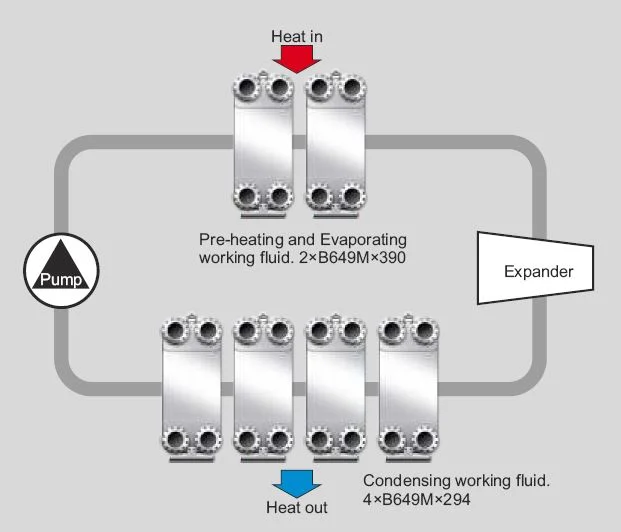
The working principle of the ORC is the same as that of the well-established Rankine Cycle describing steam-turbine operation in power plants. Confined to a closed circuit, the working fluid is first pumped to a boiler, where it is evaporated. Passing through the turbine, the organic vapor expands. Finally, it is re-condensed, usually using a closed water loop in the shell-and-tube heat exchanger. The thermodynamic cycle is finished when the condensate is pumped back to the evaporator. Evaporation occurs in the high temperature/high pressure side; condensation in the low temperature/low pressure side – the opposite of a normal refrigeration cycle.
The role of SWEP brazed plate heat exchangers
A variety of working fluids and energy converters, ranging from axial turbines to piston or Wankel expanders, can be used in ORC systems, making it possible to design solutions that perform well with a wide range of temperatures. This can be a challenge for heat exchanger producers, who must accommodate complex combinations of flow capacities, pressures, and temperatures in systems that are extremely sensitive to pressure drop. Historically, this has called for costly, bulky, tailor-made solutions. Today, however, modular SWEP brazed plate heat exchangers solve these problems and more. Technical advantages of BPHEs include simple start/stop procedures, automatic operation, minimum maintenance, good performance at partial load, and reliable, quiet operation.
When the Japanese-based company Daiichi Jitsugyo got a request from Ertec to install an ORC system in their new waste incineration plant, the company’s engineers knew that they would need a heat exchanger out of the ordinary. SWEP was their natural choice. Daiichi and Ertec have partnered with SWEP since late 2011. SWEP has also collaborated with American company, Access Energy, who manufactured the core part of the plant’s ORC system, for many years.
Delivering at least twice the capacity of the B500, the SWEP B649 is one of the most powerful heat exchangers on the market. Its compact size saves space and decreases the number of pipes and couplings required. With its core parts produced in Sweden, the B649 was designed for District Heating and Cooling networks, HVAC and Industrial projects, which demand robust, compact BPHEs that can handle close temperature approaches and high operating pressures. 95% of the material in the B649 is used to transfer heat, making them extremely efficient. Available in three different pressure classes, including a 25-bar class, the B649 saves money: on spare parts, space, energy consumption, transportation and installation.
Why choose SWEP?
“Our collaboration began in April 2012. That was our first ORC demonstration plant”, says Osamu Ito, the engineer in charge of the project at Daiichi. “The first test unit at Ertec was with our B500s”, says Seiichiro Misaki, Sales Manager for SWEP Japan.
“Since the test unit ran so well, Daiichi wanted to increase the capacity, from 75 KWe to 125 KWe and they wanted even better performance”, says Seiichiro Misaki. SWEP was able to deliver. “We have the capability to calculate and select the right brazed plate heat exchangers”, says Seiichiro Misaki, “and we also have the right capacity brazed plate heat exchangers. In many projects, we have out-performed our competitors, where we have been able to show the closest performance to our calculation and selection.” For this particular plant, SWEP’s most powerful heat exchanger was selected, the B649. “This project is a relatively small plant, but it produces a lot of power”, says Osamu Ito. “More electricity is our constant focus”. The private incineration facility in the Yamanashi Prefecture now generates clean power from the hot flue gas produced by the incineration process.
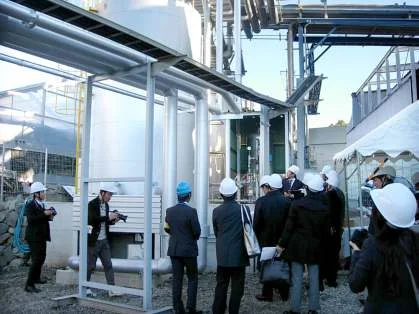
SWEP was able to obtain an approval from KHK (The High-Pressure Gas Safety Institute of Japan) in time for installation. “It stood well with the large plate number (294 and 390 plates),” says Seiichiro Misaki. The result is, so far, a great success. At the end of November 2013, a big party was held at the Ertec plant. “We had invited a lot of our customers to the site”, says Osamu. “Everyone was thrilled and congratulated us on a great plant. SWEP is a reliable partner and supplier.”
Designed to deliver maximized energy efficiency and outstanding system performance, all SWEP brazed plate heat exchanger can be used at temperatures as low as 140-160°F/60-70°C. This brings whole new possibilities for renewable energy sources with limited temperatures, such as solar power, and SWEP will definitely be a part of the further development.
More about Daiichi Jitsugyo, Ltd.
Founded in 1948 as a trading company specializing in machinery, Daiichi Jitsugyo, Ltd.’s pioneering spirit of discovery and ability to create new types of value has been passed down for generations. In keeping with this spirit, the company has grown by delivering value to manufacturing sites worldwide. Our achievements, expertise, and credibility have earned us solid market recognition as a reliable industrial machinery supplier. Meanwhile, with the evolution of manufacturing and the resulting shifts in customer needs, the company has expanded to offer total solutions, including engineering. In a rapidly changing business environment, they set new goals in 2022 and established a vision to become a “next-generation engineering trading firm” that aims to grow alongside their customers and contribute to the realization of a sustainable society.
More related stories
Related case stories

Organic rankine cycle
In a project involving ACCIONA and KEROS CERAMICA, RANK® has worked with SWEP to implement a heat recovery solution for electricity power generation.

Organic rankine cycle
ORC (Organic Rankine Cycle) technology made possible by SWEP brazed plate heat exchangers is being used in Sweden to transform waste heat into renewable electricity. This high efficiency and low maintenance way to produce sustainable electricity is being adopted by district heating systems around the world.
Address
SWEP International AB
PO Box 105
261 44 Landskrona
Sweden
Follow Us

Copyright © 2026 SWEP International AB, a Dover company
Follow Us

Copyright © 2026 SWEP International AB,a Dover company