

A breakthrough in corrosion-resistant heat exchanger technology
The transition to fossil-free energy is placing tough new demands on heat transfer solutions. As emerging technologies, such as geothermal energy, seawater cooling, hydrogen production, and ammonia infrastructure continue to develop, heat exchangers must be able to operate reliably in increasingly aggressive environments.
For SWEP, this presents both a technical challenge and an opportunity: How to extend the efficiency and compactness of stainless-steel brazed plate heat exchangers (BPHEs) into applications that have traditionally demanded the corrosion resistance of titanium or nickel alloys.
By combining SWEP’s BPHE expertise with an advanced diffusion-grown surface barrier designed to enhance the corrosion resistance of stainless-steel, SWEP and materials technology company, TerraBarrier, may have found an answer.

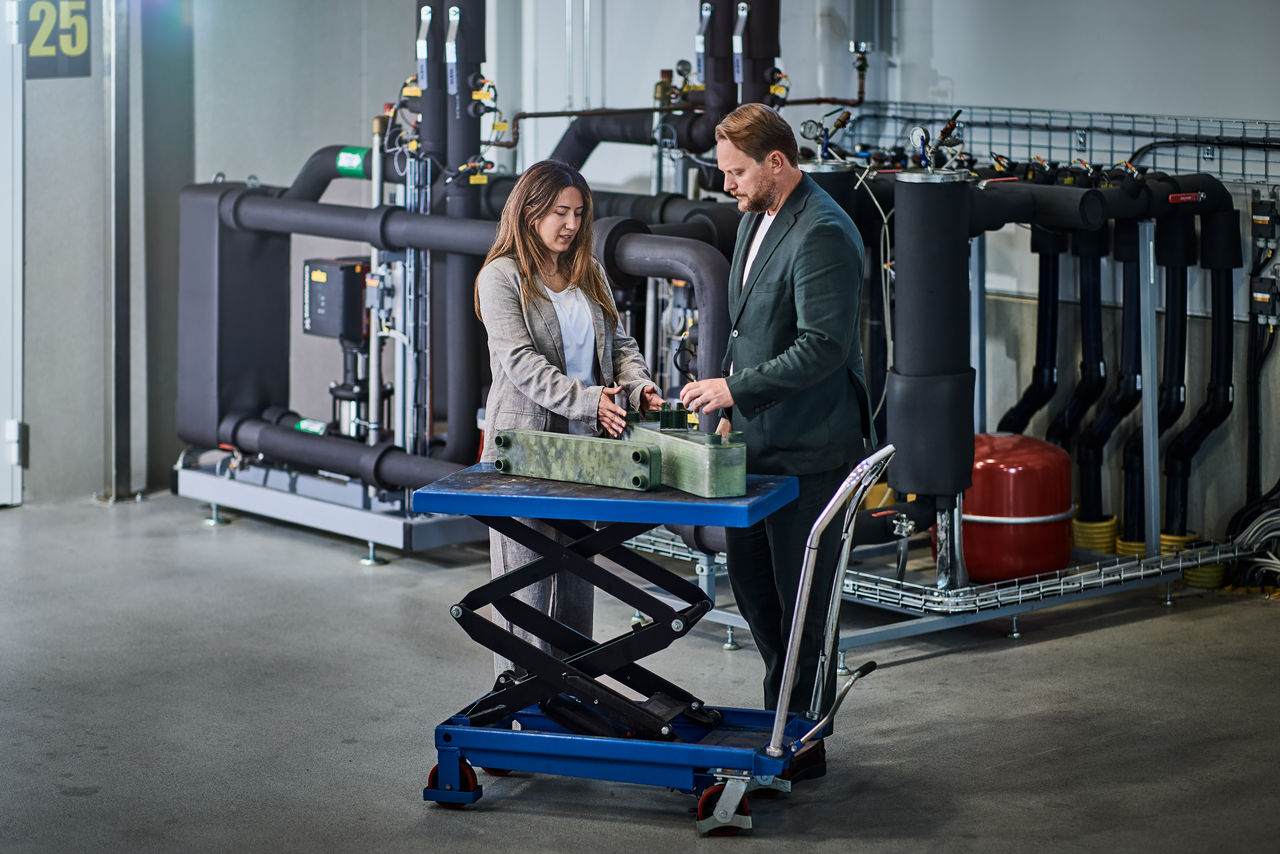
(L to R): Tomas Dahlberg, Innovation Director, SWEP; Joakim Palmberg, Marketing Director, SWEP; Dr Anna Carlson, Co-Founder and CTO TerraBarrier and Torbjörn Lindquist, CCO and Co-Founder, TerraBarrier.
Bringing SWEP technology to the most demanding applications
As a leading BPHE manufacturer, serving customers in more than 100 markets worldwide, SWEP technology is already widely used across HVAC, refrigeration, industrial, data center, and emerging energy applications. SWEP All-Stainless™ portfolio was developed specifically for applications that require high corrosion and pressure resistance.
However, some of the most aggressive environments remain challenging for conventional stainless-steel solutions. The extreme corrosiveness of geothermal fluids, seawater, hydrogen, and ammonia means that in many of these applications, titanium remains the established material of choice despite its higher cost.
SWEP and TerraBarrier are working together to change that. For SWEP, extending the capabilities of stainless steel opens the door to new applications. “SWEP’s heat exchanger technology is one of the most efficient ways to transfer energy for fluids,” explains Thomas Dahlberg, Innovation Director at SWEP. “Putting SWEP and TerraBarrier technology together will enable us to expand our reach while bringing more sustainable energy solutions to the world.”
Customer-driven innovation
The SWEP – TerraBarrier collaboration reflects SWEP’s approach to innovation: identifying real customer challenges and working with specialist partners to develop solutions for practical use. The collaboration began with a structured feasibility study to determine whether TerraBarrier’s diffusion-grown barrier could be integrated successfully with SWEP BPHEs.
The geometry of a BPHE presents a particular challenge. Internal channels are narrow, highly corrugated and designed to promote turbulence and efficient heat transfer. These complex internal surfaces are difficult to treat uniformly using conventional surface-coating technologies. TerraBarrier takes a different approach. Rather than depositing a separate coating onto the surface, it uses a controlled diffusion process to create a protective barrier from within the stainless-steel, which allows the treatment to conform to complex internal geometries.
From feasibility to validation
During the evaluation phase, heat exchangers treated using TerraBarrier’s process were subjected to extensive in-house testing by SWEP to determine not only whether the barrier could protect the material, but whether the BPHEs could retain their thermal performance, mechanical integrity, and corrosion resistance under representative conditions. The treated units passed SWEP’s internal verification and validation, demonstrating compatibility with the heat exchanger design and the requirements of the targeted applications.

“Our evaluation work has shown very successful results,” says Tomas Dahlberg. “The technology has successfully passed the verification and validation activities we have conducted so far, which gives us confidence to move into customer-based field verification.”
New opportunities for SWEP
The next stage will focus on operational field verification with selected customers. The program is centered on three strategically important areas: geothermal, seawater and hydrogen. Successful validation would create an opportunity to extend compact heat exchanger technology into applications where the properties of the materials have been a longstanding design constraint.

“If we can extend the operating envelope of stainless-steel heat exchangers into geothermal, marine, and hydrogen applications, we can remove a major materials barrier that has limited the deployment of several important fossil-free energy technologies,” says Dr Torbjörn Lindquist, CCO and Co-Founder of TerraBarrier.
SWEP’s approach to innovation
The collaboration also illustrates how SWEP approaches innovation as an ongoing process rather than a single technological breakthrough. As Joakim Palmberg, Marketing Director at SWEP, explains, “This collaboration is a strong example of how SWEP approaches innovation: by starting with real customer challenges and working with the right partners to turn advanced technology into practical, validated solutions.”
For SWEP, this type of collaboration provides a way to respond to the changing requirements demanded by the energy transition, while also building on the company’s existing expertise. It also demonstrates SWEP’s ambition to focus on innovation as the path to addressing emerging customer needs and expanding the role of BPHE technology in the transition to fossil-free energy.
As Dahlberg puts it, innovation ultimately has to return to the market: “When we believe in an opportunity, we commit to it. From there, our development process begins.”
Address
SWEP International AB
PO Box 105
261 44 Landskrona
Sweden
Follow Us

Copyright © 2026 SWEP International AB, a Dover company
Follow Us

Copyright © 2026 SWEP International AB,a Dover company